Originally posted July 2, 2010. Updated October 23, 2024.
For those of you that have read some of my previous posts on how to teach specific sounds you may have noticed a pattern. That’s because when teaching kids how to say sounds there IS a general pattern to follow even though each specific sound changes. Speech-Language Pathologists know this method as the traditional articulation therapy approach, introduced by Charles Van Riper in 1972. I wanted to outline this for you because if you understand this process, it will make teaching the sounds so much easier!
Before I get into the details of this process, please understand that there are many other factors that affect speech intelligibility such as hearing loss, apraxia, oral motor deficits, sensory issues, and phonological processes to name a few, but I will not be addressing any of these here. This post is intended to simply explain the basic structure of articulation therapy and how you can work with your child on their sounds.
So, let’s get started! The very first thing I want to know as a Speech Language Pathologist is what sounds does the child have difficulty with. As a parent you can probably list them without a problem. But if you are truly concerned about their speech development you should take them to see a Speech-Language Pathologist (SLP). SLPs can help identify the sounds your child says in error, and if they are considered delayed. They can tell you what position of the word (beginning, middle or ending) they are struggling with it in, and what sound, if any, they are substituting it with. They can identify certain patterns of errors and give you recommendations for practice. They can also tell how your child compares to other children their age. After the sounds in error are identified, determining which sounds are stimulable will help you know which sound to target first.
Stimulability
What is stimulability? A child is “stimulable” if he or she can say the sound in direct imitation of the therapist or parent. If the child is stimulable or can say the sound then you have cause to celebrate. That means your job is going to be so much easier! If the child cannot say the sound, you’ll have some work to do. You’ll need to teach them how to say the sound. This is called sound elicitation.
Sound Elicitation
Sound elicitation is the process you go through to teach the child how to say the target sound. For example, if a child cannot say the /th/ sound in imitation you break down the process for them by teaching them the placement and movement required to make the sound. For example, you might say, “Put your tongue between your teeth then blow.” After the sound is learned, meaning they can say it accurately in imitation of you then practice the sound in isolation.
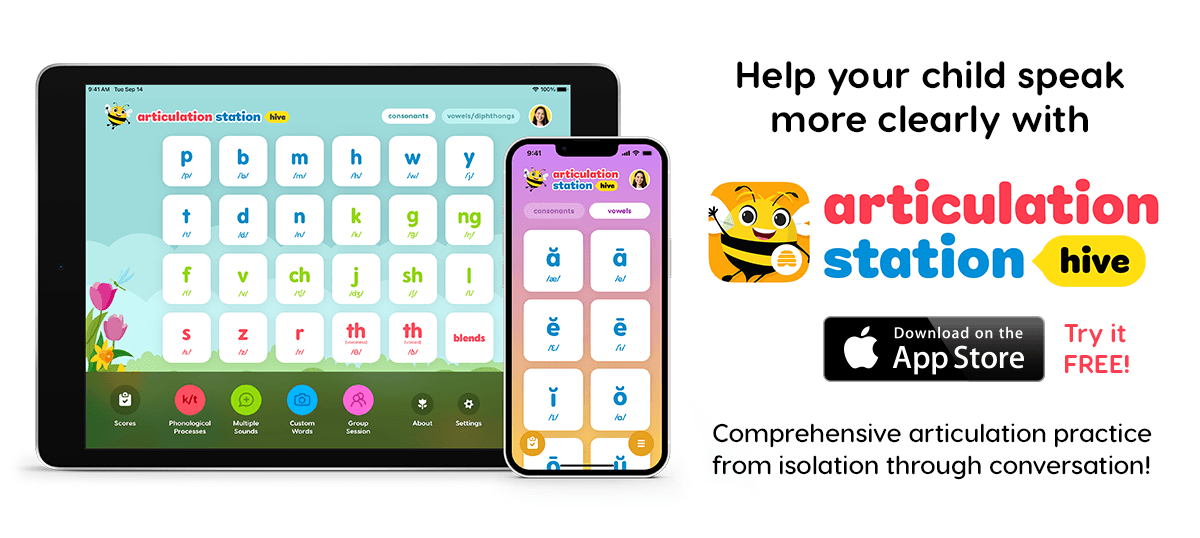
Sound in IsolationPracticing a sound in isolation means saying the sound all by itself without adding a vowel. For example, if you are practicing the /t/ sound you would practice saying /t/, /t/, /t/ multiple times in a row. The more accurate repetitions your child is able to produce the better. A good goal is 10 accurate repetitions in a row. A fun way to practice the sound in isolation is with hand cues, picture cues and letter cues. These cues serve as helpful prompts throughout each level of articulation practice. If a child forgets to say the target sound accurately at the next level you can use a hand cue, picture cue or letter cue to prompt them to say their sound correctly. Articulation Station Hive (an iOS application for iPad, iPhone and Mac) offers video models of hand cues, animated picture cues, and interactive letter cues for each sound. You can read more details on Articulation Station Hive HERE.
When the child can consistently say the sound correctly in isolation you are ready to move on to practicing the sound at the syllable level.
Sound in SyllablesPracticing a sound in syllables simply means adding vowels after the target sound, and before the target sound.
For example if the target sound is /s/ “after the target sound” would be “sa, se, si, so, and su.” This is called “initial syllable production”, meaning the target sound is in the beginning of the syllable.
If the target sound is /p/ then placing the vowel “before the target sound” would be “ap, ep, ip, op, and up. This is called “final syllable production”, meaning the target sound is at the end of the syllable.
A fun way to practice the sound in syllables is with syllable sliders, where you put two sounds together to make a word or a non-sense syllable. And with syllable spinners, where you can practice the sound in single syllables, two-syllables and three-syllable combinations. Articulation Station Hive offers fun interactive activities for both syllable sliders and syllable spinners.
When practicing the sound in syllables, pay attention to which position the child is most successful producing the sound in. If the child is the most successful with the target sound in the initial position of syllables, begin work on the target sound in the initial position of words next. If the child has more success with the target sound in the final position of syllables, practice the target sound in the final position of words next.
The goal is to work on the target sound in the sound position they are likely to be the most successful at, but not a position that is currently not a problem for them. For example, a child may exhibit a typical error pattern, or phonological process of final consonant deletion. This means they leave off the ending of most of their words. While the child can say the /m/ sound in the initial position of words with no difficulty, they never say it at the end of words. In this instance it is obvious that the sound in the initial position would not be a problem for them and would not be the place to start. Instead you would want to begin practicing the /m/ sound in the final position words.
Once your child can consistently say the sound correctly in syllables, begin practicing the sound in words.
Sound in WordsNow that you know which position of the word you want to practice the target sound in, it is time to select a word list and begin practicing the sound in words. You can make your own word list, use the downloadable word cards on Mommy Speech Therapy, or for even less work, you can use Articulation Station Hive, which has word lists for every speech sound in every sound position conveniently organized on your iPad or iPhone in fun interactive activities.
Articulation Station Hive is my favorite way to practice sounds in words. You can practice the words in flashcards and in fun matching activities. You can record the child saying the word and then playback their productions. Having the child listen to their productions gives you an opportunity to teach them how to identify correct and incorrect productions. This helps them learn to self-monitor and self-correct when they say the sound incorrectly.
Sound in PhrasesThe next step is to practice the sound in phrases. I like to start with two-word phrases. You can do this by simply putting a descriptive word in front of the target word. For example if the target word is “gum,” you might practice saying “sticky gum,” “chewy gum,” or “my gum.”
Three word phrases are another way to increase the difficulty and bridge the gap between words and sentences. To do this, simply add a third word to the descriptive phrase. For example, “his sticky gum,” or “my yummy gum.”
Articulation Station Hive offers Rotating (two-word) phrases, and Unique (3-word) phrase level activities. The rotating phrases have a lead word and a target word. When you push spin they both change. Children love to see what word combinations they get. Sometimes they make sense, and other times they make no sense at all. The silly non-sense phrases are usually their favorite. The unique phrases are 3-word descriptive phrases. They are different every time.
When the child has mastered the phrase level, they are ready to move to practicing the sound in sentences.
Sound in SentencesMy favorite way to practice sounds in sentences is with a sound-saturated “rotating sentence”. In a rotating sentence, the sentence stays the same, and only the target word changes. For example, your sentence might read, “Put the ________ in the pink purse.” Then you rotate all your practice words through the sentence. So you will get sentences like, “Put the pig in the pink purse.” Or “Put the penny in the pink purse.” This is an especially great way to practice sentences for young children who can’t read yet. They are able to memorize the sentence, or use picture prompts to help them read it aloud. You are also able to maximize the production of the target sound when you use a sentence with two or three target words in it. You can find sentence strips for rotating sentences on the free downloads page.
For more engaging, and diverse sentence options try the sentences in Articulation Station Hive. There are sound-saturated fixed rotating sentences, mixed rotating sentences and sound-saturated unique sentences which provide multiple practice opportunities regardless of the child’s age. When sounds have been mastered at the sentence level they are ready to be practiced in stories.
Sound in StoriesPracticing the sound in stories is not a step that was originally introduced with the traditional articulation therapy approach. But I have found, the addition of this step makes it easier to move the sound into conversation.
For younger clients I like to use sound-saturated stories, with picture prompts. You may use the stories I have created on my free downloads page, or for a more interactive experience try the Level 1 stories in Articulation Station Hive. The picture prompts help younger children retell the story even if they can’t read. The comprehension questions at the end help build their language skills as well.
Older clients can write their own stories using the target words. Or they can use the Level 2 Stories in Articulation Station Hive. Whichever stories they use, reciting the story for an audience is a great way to help prepare them to use their sounds correctly in conversation.
Sound in ConversationIn the therapy setting this step can be a little tricky. I like to use conversation questions to get my clients talking. You can use your favorite conversation starters or you can use the conversation question prompts in the conversation activities found in Articulation Station Hive. However you decide to do it, be sure to set a specified time to focus on the correct production of the target sound during conversation. Be sure to correct any inaccurate productions of the target sound at this time. Practicing the sound in conversation really helps with generalization. Once the sound has been mastered in conversation the child should begin to generalize the correct production of the sound in all conversation settings.
As you may have noticed the process of articulation therapy is all about repetition. Repetition at each level strengthens their speech muscles, improves their accuracy, and builds their confidence which prepares them for success. A quick review of the process of articulation includes… First, practice the sound in isolation, then in syllables, words, phrases, sentences, stories, and finally in conversation. The only thing that changes in this process is how to elicit the different sounds. The basic pattern of how to teach each sound remains the same.
For more ideas on how to elicit each sound refer to the posts on Mommy Speech Therapy for how to teach the sounds. Or go to the quick tips in Articulation Station Hive.
You can download the FREE “Process of Articulation Therapy” reference chart by clicking HERE or on the download link below. This fun, FREE chart outlines the entire process step by step.

I hope this will give you a good starting point in working with the “misarticulations” in your child’s speech. Remember to be patient, and to make it fun!


66 Comments